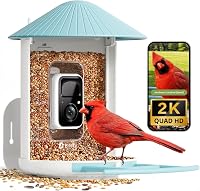
9 Best Bird Feeder With Camera and Solar (November 2026)
The best solar bird feeders with cameras include the Cadrali 3K HD Smart Bird Feeder (best overall), the Kiwibit Solar Smart Bird Feeder with Camera for 4K without a subscription, and the Minikey Smart Bird Feeder with Camera Outdoor (best solar setup for shady yards).
On this page (9 sections)
- The best solar bird feeders with cameras, ranked
- How these solar feeder cameras compare
- How we compared these solar bird feeders
- Does a solar bird feeder camera work in shade?
- Do you need a subscription to identify birds?
- What video quality do you need in a feeder camera?
- How much seed capacity should a solar feeder hold?
- What should you check before mounting a solar feeder camera?
- Verdict: which solar feeder camera should you buy?
The best bird feeder with camera and solar for most yards is the Cadrali 3K HD Smart Bird Feeder, because its 3W panel and 5000mAh battery keep the 3K camera running and its 5-minute mount works on a wall, tree or pole. For 4K footage without an AI subscription, pick the Kiwibit Solar Smart Feeder.
A solar panel changes the daily routine more than any other feature on these feeders. Once the battery and panel balance out, you stop climbing a ladder to charge a camera, and the feeder keeps watching birds while you're at work.
We compared nine solar-powered feeder cameras on panel size, battery capacity, video quality, AI features and what each one charges for. Our scores weigh specs, features and buyer feedback against what you're shopping for.
If you already know you want sharper video, our roundup of the best bird feeders with a 4K camera covers the top end. For a feeder that sticks to the glass, see the best window bird feeders with cameras.
Our picks at a glance
-
1

-
2
 Best for 4K without a subscription
Kiwibit Solar Smart Bird Feeder with Camera
9.5/10 our score
See it on Amazon -
3
 Best solar setup for shady yards
Minikey Smart Bird Feeder with Camera Outdoor
8.8/10 our score
See it on Amazon
- 4
 Check it
Bird Buddy Pro Solar Smart Bird Feeder
Best app and bird community - 5
 Check it
RichBird Smart Bird Feeder with Camera
Best for free AI recognition - 6
 Check it
NETVUE Birdfy Feeder 1 2K AI Camera
Best for free cloud storage - 7
 Check it
Kiwibit Solar 4K HDR Bird Feeder
Best 4K detail for close watching - 8
 Check it
Kiwibit 4K 8MP Solar Bird Feeder
Best for flexible solar placement - 9
 Check it
HEAPETS 2K Solar Bird Feeder Camera
Best budget first feeder
The best solar bird feeders with cameras, ranked
The Cadrali leads on all-round balance, while the rest of the list splits into feeders that save on subscriptions, handle shade better or cost less up front. Every model here pairs a solar panel with a rechargeable battery, so none needs a cable run to the yard.
Cadrali 3K HD Smart Bird Feeder: Best overall
- 3K HD video day and night
- 3W solar panel and 5000mAh battery
- AI ID for 10,000+ species
- IP65 waterproof and chew-proof
A sharp 3K camera and a solar panel that keeps the battery topped up, with AI alerts and quick multi-mount setup.
Pros
- 3K video with night view
- Solar panel plus large battery
- Five-minute wall, tree or pole mount
Cons
- 2.4GHz Wi-Fi only
- AI recognition needs a subscription after the trial
Cadrali suits a backyard where the feeder sits in reasonable daylight and you want clear footage without much fuss. The 3K camera streams day and night, so an evening visit still shows feather detail instead of a dark shape.
The 3W solar panel and 5000mAh battery are sized for year-round running, and the housing is IP65 waterproof and chew-proof. That matters if raccoons or squirrels work the feeder in wet weather.
AI identification covers more than 10,000 species and pushes alerts to your phone. The 30-day trial covers recognition and cloud storage, then the subscription renews on its own unless you cancel.
Storage otherwise goes on a micro SD card up to 128GB, sold separately. That gives you a free path: run the trial to see how often species names arrive, then keep footage on a card if the plan isn't worth it.
Mounting takes about five minutes on a wall, tree or pole. It's the safest first solar feeder for most people, as long as your Wi-Fi reaches the yard on 2.4GHz.
The camera also records in MPEG-4, which keeps files small enough for a modest card to hold plenty of clips.
Kiwibit Solar Smart Bird Feeder with Camera: Best for 4K without a subscription
- 4K video and 8MP photos with HDR
- Lifetime AI bird ID included
- Dual solar panels and 5200mAh battery
- 1.5L detachable hopper
Ultra HD footage and lifetime AI recognition without a subscription, backed by dual solar panels and a big detachable seed hopper.
Pros
- 4K HDR video and 8MP photos
- Lifetime AI ID with no subscription
- Large detachable hopper for easy cleaning
Cons
- 2.4GHz Wi-Fi only
- Heavier than the smallest feeders here
Kiwibit is the pick when 4K matters and you'd rather not pay monthly for bird ID. The 8MP sensor captures 4K video with HDR color and a 132-degree view, and the AI recognition for 10,000+ species comes with the purchase for life.
That lifetime access also brings KeyShot galleries, visit summaries and automatic highlights, plus up to 60 days of cloud storage for clips up to 3 minutes long.
Dual solar panels feed a 5200mAh battery, so the feeder keeps alerting and streaming without frequent charging. The 1.5L hopper detaches completely, which makes rinsing and refilling a quick job.
The ABS and polycarbonate body is built for outdoor use.
Sharing goes to 20 people, so family can watch the live feed from their own phones. The feeder also works with Kiwibit's hummingbird and squirrel-proof attachments if you want to widen the guest list.
A micro SD card up to 512GB covers local storage, so you can keep months of clips without the cloud.
The trade-off against the Cadrali is resolution versus subscription cost: Kiwibit gives you sharper video and free AI, while Cadrali offers a simpler first setup. Pick Kiwibit if you'll use AI ID heavily and want the best picture.
Minikey Smart Bird Feeder with Camera Outdoor: Best solar setup for shady yards
- Three solar panels plus 5200mAh battery
- 3K video with 160-degree view
- AI ID for 10,000+ species
- Hummingbird feeder included
Two built-in panels plus a third external panel give this feeder more ways to catch sun, with a wide 3K lens and a hummingbird attachment.
Pros
- Three solar panels for cloudy days
- 160-degree wide view
- Hummingbird feeder in the box
Cons
- AI recognition needs a subscription after 30 days
- Only two mounting types
Minikey answers the common solar problem: a feeder in shade. It carries two 2W panels on the roof plus a 3W external panel, giving you three surfaces to catch light and a 5200mAh battery to store it.
The external panel can sit away from the feeder, so branches or a shaded wall don't block every charge.
Minikey says a full charge can last up to 58 days on cloudy days, so a stretch of gray weather won't stop recordings. The 3K lens offers a 160-degree view and night vision, which is wider than most feeders here.
A 5dB external antenna works with the 2.4GHz Wi-Fi to hold the signal at the far end of a yard.
A small hummingbird feeder and fruit fork come in the box, and the 1.25L seed hopper uses a funnel roof in food-grade PE. The tray detaches for cleaning.
It's rated from -10℃ to 45℃, so it runs through cold winters and hot summers.
AI species recognition needs a subscription after the 30-day trial. If shade is your main worry and you don't mind a plan for AI, Minikey is the better fit than the top two picks.
Its mount list is shorter, though, with only tree and wall options.
Bird Buddy Pro Solar Smart Bird Feeder: Best app and bird community
- 2K video and 5MP HDR photos
- Solar roof included
- AI species and individual bird ID
- Health detection for visiting birds
A polished app with AI species and individual bird tracking, sold with a solar roof and a hanger for branch mounting.
Pros
- Solar roof in the box
- AI tracks individual birds and health signs
- Hanger and universal mount included
Cons
- Premium subscription needed for advanced AI
- Smallest seed capacity here
Bird Buddy suits the birdwatcher who wants an app as much as a feeder. The 2K camera with a larger sensor and HDR produces 5MP photos and 2K video, and the app's AI identifies species and even individual birds.
The 1/2.7-inch sensor helps in low light, so early and late visits stay clearer.
The AI also flags signs of illness in visiting birds. A premium subscription is required for those advanced tools, though core features like live streaming and postcards stay free.
You can invite up to ten people to the feeder and control what gets shared.
The solar roof is included, along with a metal hanger and a universal pole mount. Setup runs through Bluetooth pairing and 2.4GHz Wi-Fi, guided step by step in the app.
The kit also has a seed scoop and USB-C cable, so you can charge it indoors before it goes outside.
Its 0.9L capacity is the smallest in this group, so you'll refill more often. The mount kit covers a pole and a branch, but a wall mount is sold separately.
Choose it for the app and the community features, not for seed volume or raw resolution.
RichBird Smart Bird Feeder with Camera: Best for free AI recognition
- 2.5K QHD live video
- Free AI ID for 10,000+ species
- 4400mAh battery and solar panel
- 2L seed container
AI species recognition costs nothing here, and the 2L container means fewer refills, all kept running by a solar panel and 4400mAh battery.
Pros
- AI identification without a subscription
- Large 2L seed container
- Two-way audio to warn off squirrels
Cons
- Lower video resolution than the top picks
- Live sharing capped at five users for free
RichBird is the budget-friendly route to AI bird ID. Species recognition for 10,000+ birds is free, with no subscription, and the COOLFLY app adds a community feed where you can share sightings.
You can also upload extra bird images to its Chirpchat feature for a second opinion on a species.
Video runs at 2.5K QHD, below the 3K and 4K cameras here but sharp enough to tell a finch from a sparrow. A 4400mAh battery and a solar panel keep it running, and the 2L container holds more seed than most rivals.
The wide-mouth top means refills don't need disassembly.
Two-way audio lets you warn off squirrels, and up to five people can watch live for free. The feeder is waterproof, snow-resistant and heat-tolerant, and setup takes four steps from unboxing to mounting on a pole, tree or wall.
The box itself is gift-ready.
The trade-off is picture quality against the top picks. If free AI recognition and fewer refills matter more than 4K, RichBird is the smarter buy.
NETVUE Birdfy Feeder 1 2K AI Camera: Best for free cloud storage
- 2K AI camera with color night vision
- Solar panel and 5200mAh battery
- 5GB free cloud storage
- AI ID for about 11,000 species
Core features stay free, including 30-day video history and 5GB cloud storage, with solar power and color night vision.
Pros
- 30-day video history and 5GB cloud storage free
- Color night vision
- Large 1.5L seed capacity
Cons
- AI recognition needs a subscription
- 2K resolution only
NETVUE Birdfy stands out for what stays free. Core features include 30-day video history, 5GB cloud storage, live streaming and sharing, and the app connects a large community of birdwatchers.
Free storage covers saved videos and photos, and you can download clips to keep without paying.
The 2K AI camera records color night vision, so nocturnal visitors are easier to identify. A solar panel and 5200mAh battery keep it powered, and the 1.5L capacity matches the top pick.
NETVUE says the built-in 5200mAh battery supports up to 36 months per charge when paired with the solar panel.
Its AI species recognition needs a subscription, so free storage rather than free AI is the reason to choose it. The 2K resolution also trails the 3K and 4K models here.
The app's AI covers about 11,000 species, and you can invite 20 or more guests to watch live without a fee.
Pick Birdfy if you want a long free recording history and an active app community, and you're happy with 2K video. It's also the easiest of the group to share with family, since the free tier already covers group viewing.
Kiwibit Solar 4K HDR Bird Feeder: Best 4K detail for close watching
- 4K HDR video and 8MP photos
- Built-in dual solar panels
- 132-degree wide lens
- Two-way audio
Top-tier 4K HDR footage in a lighter feeder, though the AI recognition sits behind a paid subscription.
Pros
- 4K HDR video
- Lighter than the other Kiwibit models
- Perch extender fits larger birds
Cons
- AI ID needs a Premium subscription after 30 days
- Smaller 1L seed hopper
Kiwibit's 4K HDR model suits the detail-obsessed watcher. The 8MP sensor and HDR processing bring out color and contrast in close footage, and the 132-degree lens plus perch extender welcomes larger birds.
Infrared night vision records black-and-white clips after dark, and two-way audio lets you listen and talk back.
Built-in dual solar panels feed a 5200mAh battery, and the whole feeder weighs less than the other Kiwibit models here. The 4.4W of combined solar is a strong charge for its size.
A dual-seed hopper lets you offer two blends to draw more species, from finches to cardinals.
The 1L hopper is the smaller of the two Kiwibit feeders, so you'll refill more often in a busy yard. AI recognition needs the Kiwibit Premium subscription after 30 days, though the trial covers KeyShot galleries and visit summaries.
It includes a 12-month warranty.
Choose it for the best close-up footage in a lighter body. Skip it if seed capacity or free AI tops your list.
Kiwibit 4K 8MP Solar Bird Feeder: Best for flexible solar placement
- 4K live streaming and 8MP photos
- Adjustable external 3W solar panel
- 5200mAh battery
- 1.5L seed capacity
A panel you can angle and move away from the feeder makes this the pick when the mounting spot sits in shade.
Pros
- External solar panel tilts and moves
- 4K live view without a subscription
- Works from -4°F to 122°F
Cons
- AI features need a subscription after 30 days
- 2.4GHz Wi-Fi only
This Kiwibit model solves shade with hardware. Its external 3W solar panel tilts and sits away from the feeder, so you can point it at the sun even when the feeder hangs in shadow.
A 5200mAh battery stores the charge, and USB-C charging covers long cloudy spells.
The camera streams 4K without a subscription, and recorded moments share with up to 20 people. It's rated from -4°F to 122°F and holds 1.5L of seed in a detachable hopper.
Real-time motion alerts arrive over a high-gain 2.4GHz Wi-Fi connection.
The AI features, including species ID, need a subscription after the 30-day trial. The trial also opens Bird Stories, nature expert insights and activity charts.
A micro SD card up to 512GB keeps footage local, and cloud storage gives a one-day rolling history for free.
The trade-off is the separate panel, which needs its own mounting spot. If your only good feeder location is shaded, that flexibility is worth the extra planning.
A 1-year replacement warranty backs it up.
HEAPETS 2K Solar Bird Feeder Camera: Best budget first feeder
- 2K HD live video
- Built-in solar panel
- AI ID for 10,000+ species
- Spill-proof seed container
A low-cost entry point with a solar roof and simple setup, though video and features stay basic.
Pros
- Built-in solar panel
- Simple multi-mount setup
- Two users can watch live at once for free
Cons
- 2K video only
- AI ID needs a paid plan after one month
HEAPETS is the low-cost way to try a solar feeder camera. The 2K camera streams live to your phone, and the built-in solar panel keeps the battery topped up without frequent charging.
A USB-C cable is included for wired power or backup charging.
It covers AI identification for 10,000+ species with a one-month trial, then a monthly or yearly plan. Motion alerts tell you when a bird arrives, and the spill-proof container keeps feeding tidy.
The adjustable 360-degree perch lets birds land from any side.
Mounting works on a tree, pole or wall, and the feeder is rainproof and heat-tolerant. Two people can watch live at once for free, and you can share recorded clips with as many people as you like.
The body is ABS and weighs about 1.57 kg.
Its specs trail the rest of the list: 2K video, AI behind a paid plan and a smaller 1.25L hopper. It's a reasonable first feeder for a casual watcher, not the pick for someone chasing 4K footage.
If you only want to see who visits and hear the alerts, it covers that at a low price.
How these solar feeder cameras compare
The table lines up the features that decide daily use: video quality, panel setup and what each feeder charges for. Sort your priorities before you pick.
| Product | Best for | Video | Power | Storage | Our score |
|---|---|---|---|---|---|
| Cadrali 3K HD Smart Bird Feeder | overall | 3K HD | 3W solar panel, 5000mAh battery | Micro SD up to 128GB or cloud | 9.7 |
| Kiwibit Solar Smart Bird Feeder with Camera | 4K without a subscription | 4K, 8MP photos | Dual solar panels, 5200mAh battery | 9.5 | |
| Minikey Smart Bird Feeder with Camera Outdoor | solar setup for shady yards | 3K HD | Three solar panels, 5200mAh battery | 8.8 | |
| Bird Buddy Pro Solar Smart Bird Feeder | app and bird community | 2K, 5MP photos | Rechargeable battery plus solar roof | 8.6 | |
| RichBird Smart Bird Feeder with Camera | free AI recognition | 2.5K QHD | Solar panel, 4400mAh battery | 8.4 | |
| NETVUE Birdfy Feeder 1 2K AI Camera | free cloud storage | 2K | Solar panel, 5200mAh battery | 8.2 | |
| Kiwibit Solar 4K HDR Bird Feeder | 4K detail for close watching | 4K HDR, 8MP photos | Built-in dual solar panels, 5200mAh battery | 7.7 | |
| Kiwibit 4K 8MP Solar Bird Feeder | flexible solar placement | 4K, 8MP photos | External 3W adjustable solar panel, 5200mAh battery | 7.6 | |
| HEAPETS 2K Solar Bird Feeder Camera | budget first feeder | 2K | Built-in solar panel | 6.5 |
Our scores weigh specs, features and buyer feedback against what you're shopping for. A 9+ score means the feeder balances video, power and cost well for most yards.
Anything in the 7s or 6s trades away one of those for a specific need.
The AI subscription question separates the field more than the camera specs do. Three feeders here keep AI free: the Kiwibit Solar Smart Feeder and RichBird include it with no plan, and the Kiwibit 4K 8MP model charges only for AI while its 4K live view stays free.
The rest run a trial and then charge. Over a few years, that plan can cost more than the gap in video quality between 2K and 4K.
How we compared these solar bird feeders
We compared nine feeder cameras that pair a solar panel with a rechargeable battery. Panel count and battery capacity came first, because a camera without steady power is a camera that stops watching.
Next came video quality, measured by the stated resolution and sensor type: 4K and 3K models beat 2K when you want to tell similar species apart. We also weighed AI features and whether they're free or subscription-based, since that changes the long-term cost.
Mounting options and capacity rounded out the comparison. A feeder that holds 2L needs fewer refills than one at 0.9L, and a model that mounts only on a tree limits where you can place it.
We didn't test these feeders ourselves. Everything here comes from the specs and features each brand publishes.
If you want the full checklist for picking one, read our camera bird feeder buying guide.
Does a solar bird feeder camera work in shade?
Partly. A solar feeder camera needs daylight to charge, so shade slows charging and leaves the battery to carry the load.
A model with an external or adjustable panel does better in shade than one with panels fixed to the roof.
The Kiwibit 4K 8MP feeder lets you move its 3W panel into the sun. Minikey adds a third external panel to two roof panels.
If your yard is mostly shaded, look for either of those before a roof-only design.
Panels on the roof
Roof panels are the simplest to live with, since there's nothing extra to mount. Cadrali, Kiwibit and HEAPETS all put the panel on top.
These suit a feeder that gets a few hours of direct light.
Panels you can move
External panels tilt and sit away from the feeder. That flexibility matters when branches block the sun or you mount the feeder against a north-facing wall.
The trade-off is a second mounting spot to plan.
Do you need a subscription to identify birds?
Not always. Some solar feeders include AI species recognition with the purchase, while others charge after a short trial.
The difference can matter more than the camera's resolution.
Kiwibit's Solar Smart Feeder includes lifetime AI recognition for 10,000+ species. RichBird also offers AI identification without a subscription.
Cadrali, Minikey, Bird Buddy, the Kiwibit 4K models and HEAPETS all require a plan after a trial period.
Free AI identification
Choose one of these if you want species names without a monthly bill. Kiwibit covers 10,000+ species and adds KeyShot galleries.
RichBird covers a similar count and puts its community features in the COOLFLY app. Both keep the door open to free viewing long after the first month.
AI behind a plan
These feeders typically include a 30-day trial. After that, the subscription renews unless you cancel.
Decide whether you'll use species ID enough to justify the plan before choosing one of them. If you'd rather not pay, check the free storage and sharing terms first, because those usually stay open even when AI doesn't.
What video quality do you need in a feeder camera?
2K is enough to tell most backyard birds apart. Go to 3K or 4K when you want to read feather detail and color more precisely, or when you plan to crop and zoom into recordings.
The Cadrali and Minikey offer 3K, while the two Kiwibit 4K models and the Kiwibit Solar Smart Feeder shoot in 4K. Bird Buddy, NETVUE Birdfy, RichBird and HEAPETS sit at 2K or 2.5K.
4K and 3K models
Sharper cameras suit close-up watching and slow, careful species checks. The Kiwibit Solar Smart Feeder pairs 4K with 8MP photos and HDR color.
The Cadrali's 3K view covers day and night. The Kiwibit 4K HDR model adds a wider lens and a perch extender for bigger birds.
2K models
A 2K camera keeps the price lower and the file sizes smaller. For casual watching and instant alerts, it does the job, and models like NETVUE Birdfy add color night vision to make evening visits clearer.
Bird Buddy pairs its 2K video with a larger sensor for low light.
How much seed capacity should a solar feeder hold?
Plan on 1.5L or more for a busy yard, and accept more refills with smaller hoppers. Capacity decides how often you climb a ladder, so it's worth weighing against video quality.
The RichBird leads with 2L. Cadrali, Kiwibit, NETVUE Birdfy and the Kiwibit 4K 8MP model hold 1.5L.
Minikey and HEAPETS hold 1.25L, and the Kiwibit 4K HDR holds 1L.
Large hoppers for busy yards
A 2L hopper means fewer trips when finches and cardinals empty the feeder fast. RichBird's wide-mouth top also makes refills quick.
A larger hopper is the easier life for a yard with heavy traffic. If you fill with a scoop from a big bag, the extra capacity saves real time across a season.
Smaller hoppers for light traffic
A 1L or 1.25L feeder suits a quiet yard or one where you enjoy topping up. Smaller hoppers are lighter to handle and cheaper to fill, but they need checking more often in peak season.
The Bird Buddy's 0.9L is the lightest of all, so it's easy to lift down for a refill.
What should you check before mounting a solar feeder camera?
Check Wi-Fi reach and daylight first. Every feeder here runs on 2.4GHz Wi-Fi only, and the mounting spot needs enough light for the panel.
Measure the reach from your router to the yard. A stable 2.4GHz signal matters more than speed, because the camera only needs to push alerts and live video.
If the signal is weak at the feeder, a Wi-Fi extender near the window helps. Minikey adds a 5dB external antenna to hold the connection at long range.
Wall, tree or pole mounting
Most models mount on all three. Cadrali takes about five minutes on a wall, tree or pole.
The Bird Buddy Pro includes a hanger for a branch and a universal pole mount. Minikey lists only tree and wall mounts, so check the hardware in the box before you plan a pole.
Pick the spot with the clearest view and the most light.
Placement for shade and safety
Keep the feeder away from low branches that give squirrels a route in. If your best viewing spot is shaded, choose a movable panel.
Avoid spots where the feeder sits in the path of a downpipe or where rain splashes up from a hard surface. A spot near a window also makes cleaning and refilling quicker.
Verdict: which solar feeder camera should you buy?
The Cadrali 3K HD Smart Bird Feeder is the best bird feeder with camera and solar for most yards, with steady solar power and a clear 3K view in a feeder that mounts in minutes. Buy the Kiwibit Solar Smart Feeder if you want 4K video and lifetime AI without a plan.
Pick the Minikey for a shaded yard, the Bird Buddy Pro for its app and health detection, or the RichBird if free AI ID and a 2L hopper matter most. The NETVUE Birdfy suits anyone who wants long free cloud storage, while the two Kiwibit 4K models split between close-up detail and a movable panel.
The HEAPETS is the budget first step.
Whichever you choose, mount it where the panel gets light and the 2.4GHz signal holds. That pairing, not the resolution number, decides whether the feeder keeps watching all year.
For the wider checklist on cameras and apps, see the best smart bird feeders roundup.
Our top 3 picks at a glance
-
1
-
2
Best for 4K without a subscription
Kiwibit Solar Smart Bird Feeder with Camera
9.5/10 our score
See it on Amazon -
3
Best solar setup for shady yards
Minikey Smart Bird Feeder with Camera Outdoor
8.8/10 our score
See it on Amazon
Frequently asked questions
Do solar bird feeders with cameras need direct sun?
They need some daylight to charge, and a panel in full sun performs best. If your mounting spot is shaded, choose a model with an external or adjustable panel you can angle toward the light, like the Kiwibit 4K 8MP.
Do I need a subscription for AI bird identification?
It depends on the feeder. The Kiwibit Solar Smart Feeder includes lifetime AI recognition with the purchase, while Cadrali, Minikey and Bird Buddy charge for AI features after a trial.
Check what's free before you buy.
What Wi-Fi does a solar bird feeder camera use?
Every feeder here runs on 2.4GHz Wi-Fi only. That band reaches further outdoors than 5GHz and keeps the connection stable at the distance a feeder usually sits from the router.
How do I keep squirrels off a solar bird feeder camera?
A few feeders here include two-way audio so you can talk through the app to scare squirrels away. Kiwibit also sells squirrel-proof attachments for its feeders.
A baffle on the pole adds another layer of defense.
Where can I mount a solar bird feeder with a camera?
Most models mount on a wall, tree or pole. The Bird Buddy Pro ships with a hanger for a branch and a universal pole mount.
Pick a spot with a clear view of the feeder and enough light for the panel.
What happens to recordings when the battery runs low?
The solar panel keeps the battery charged in normal daylight, so recordings continue without much attention. In long cloudy spells, recordings pause until the battery recovers.
A micro SD card keeps footage on the device.