9 Best Bird Feeder Cameras With Solar Panel (November 2026)
The best bird feeder cameras with solar panels include the NETVUE Solar Panel for Bird Feeder Camera (best overall), the Fazoxo Bird Feeder with Camera for cloud AI bird ID, and the SOVMIKU Vicohome 5V Solar Panels for Security for mixed camera brands.
On this page (5 sections)
The best bird feeder camera with solar panel for most yards is the NETVUE Solar Panel for Bird Feeder Camera, because its 3W Type-C panel and 360° swivel bracket keep a feeder camera topped up without a ladder trip. Pick a solar kit with its own camera only when you want the feeder included.
Solar is the quiet part of a feeder camera setup. The camera gets the attention, but the panel decides whether you're climbing a step stool every week to pull the camera for a charge.
That's why this list puts panels first and treats each camera's own solar roof as a backup plan. If you're still working out which camera you want, our camera bird feeder buying guide covers the basics first.
This post assumes you've settled on solar and want the best panel-and-camera pairing.
Our picks at a glance
-
1
-
2
-
3
 Best for mixed camera brands
SOVMIKU Vicohome 5V Solar Panels for Security
9.5/10 our score
See it on Amazon
- 4
 Check it
Kiwibit Solar Smart Bird Feeder with Camera
Best for no-subscription 4K - 5
 Check it
Minikey Smart Bird Feeder with Camera Outdoor
Best for cloudy climates - 6
 Check it
RichBird Smart Bird Feeder with Camera
Best for sharing with family - 7
 Check it
NETVUE Birdfy Feeder 1 2K AI Camera
Best for a proven app - 8
 Check it
Kiwibit Solar 4K HDR Bird Feeder
Best for close-up detail - 9
 Check it
HEAPETS 2K Solar Bird Feeder Camera
Best budget solar feeder
The best bird feeder camera with solar panel for each yard
The NETVUE panel wins overall because it separates the sun-catching job from the feeder, so you can put the panel where the light actually is. The solar feeder kits below are the better pick when you'd rather not buy a camera and a panel separately.
NETVUE Solar Panel for Bird Feeder Camera: Best overall
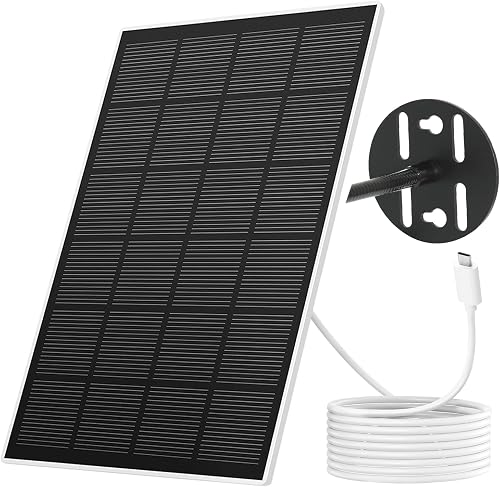
- 3W solar panel
- Type-C charger
- IP65 waterproof
- 360° swivel bracket with 90° tilt
- About 3 m cable
A dedicated solar panel for Type-C feeder cameras. The 360° bracket and 3 m cable let you chase the sun without moving the feeder.
Pros
- Mounts separately from the feeder
- Long cable for sunny placement
- ETFE panel material
Cons
- Panel only, so you need a Type-C feeder camera already
This panel suits anyone who already owns a Type-C feeder camera and is tired of indoor charging. It's a 3W ETFE panel with an IP65 rating, so it handles rain and hail without a cover.
The wattage is modest on paper, but a feeder camera that wakes for short clips and alerts draws little, so 3W of steady daylight is enough to keep the battery near full in most yards.
The part that makes it the top pick is the mounting. A 360° swivel bracket with 90° tilt lets you aim the panel at the sun's arc, and about 3 m of cable means you can mount it on a fence, shed or pole away from the feeder.
At 7.6 x 1.77 x 5.28 inches and about a pound, it's light enough for a single wall screw or a strap on a post.
That cable matters more than the wattage in a shaded yard. Hang the feeder under a tree for bird comfort, then run the panel out to open sky.
Its trade-off against the kits here is simple: no camera. If you don't already have a Type-C feeder, the panel alone won't start you birdwatching.
It's also a single 3W panel, so a camera with heavy live-stream use may still need an occasional indoor charge in winter.
Fazoxo Bird Feeder with Camera: Best for cloud AI bird ID
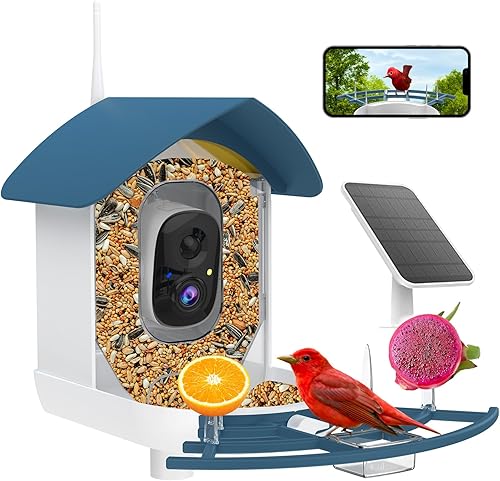
- Solar panel included
- 5200mAh battery
- 2.4GHz Wi-Fi
- 160° field of view
- AI bird ID for 10,000+ species
A complete solar feeder kit with AI species ID and a microphone and speaker for two-way listening. Suits buyers who want the feeder and panel in one order.
Pros
- Solar panel and 5200mAh battery in the box
- AI identifies 10,000+ species
- Two-way audio
Cons
- AI and cloud storage need a paid plan after the trial
- 2.4GHz networks only
Fazoxo is the pick for buyers who want AI species ID without assembling a panel and camera pair. The kit includes a solar panel and a 5200mAh battery, so the feeder runs on sun and holds charge for dark stretches.
The panel sits on the feeder's roof, which keeps the cable run short and the install simple.
Its 160° field of view catches birds at the perch and on the roof. A microphone and speaker let you listen to birdsong and talk back, which is handy for shooing squirrels without opening the door.
The 1.3 L hopper holds a decent amount of seed for a small yard.
The honest catch is the subscription. AI bird ID and cloud storage both come with a one-month trial, then need a paid plan.
Without one, you can still use a microSD card up to 128GB for local recording. Note that the AI feature needs the cloud plan to work at all, so free AI isn't really an option here.
It also connects on 2.4GHz Wi-Fi only. If your router broadcasts both bands under one name, split them before setup.
The ABS and polycarbonate body handles rain, and the mounting kit covers pole, stake, tree or freestanding setups.
Choose Fazoxo over the NETVUE panel if you want one order that includes everything. Skip it if you refuse a monthly fee and want AI ID to stay free.
SOVMIKU Vicohome 5V Solar Panels for Security: Best for mixed camera brands
- 5W output
- USB-C port with Micro-USB adapter
- 9.8 ft cable
- IP65 shell
- 360° horizontal and 180° vertical tilt
A 5W panel that fits Type-C and Micro-USB feeder cameras. The long cable and wide tilt range help when your only sunny spot is far from the feeder.
Pros
- Works with two connector types
- 9.8 ft cable
- Heavy-duty adjustable mount
Cons
- Needs a separate camera
- Panel is bulkier than a dedicated feeder add-on
SOVMIKU solves a different problem: mixed hardware. Its 5W panel has a USB-C port and a Micro-USB adapter in the box, so it can feed a Type-C feeder camera or an older Micro-USB security cam.
The monocrystalline cells and a light-tracking chip help it pull more from low or angled sun than a basic panel would.
The 9.8 ft cable is the longest here, and the mount tilts 180° vertically and 360° horizontally. That combination helps when your feeder sits in shade but the roof edge gets full sun.
The mount is heavy-duty ABS and needs no tools to set on a wall, fence or stake.
It's rated IP65 and has a triple-protection circuit for overcharge, short circuit and reverse current. SOVMIKU says the panel works from 32°F to 113°F, so it covers a full year in most climates.
At 0.27 kg it stays light on a fence post.
The trade-off is size and purpose. It's a general security-camera panel rather than a feeder-specific add-on, so it's bulkier than the NETVUE unit.
It's still a panel only, which means you need a camera to plug it into.
Pick it when you own more than one camera brand and want a panel that moves between them. It's also the better fit when your only sunny spot is far from the feeder.
Kiwibit Solar Smart Bird Feeder with Camera: Best for no-subscription 4K
- True 4K video and 8MP photos
- Dual solar panels
- 5200mAh battery
- Lifetime AI bird ID included
- 132° wide view
A 4K solar feeder that includes lifetime AI recognition without a monthly plan. The dual panels and detachable seed hopper suit a busy backyard.
Pros
- Lifetime AI with no subscription
- True 4K HDR video
- Two solar panels plus battery
Cons
- Premium price tier
- 2.4GHz Wi-Fi only
Kiwibit's 4K feeder is the strongest kit here for buyers who don't want a subscription at all. Lifetime AI bird ID is included in the purchase, covering 10,000+ species plus 60 days of cloud storage for clips up to 3 minutes.
That's a rare combination, since most kits here charge for species ID.
The camera shoots true 4K video and 8MP photos with HDR color and a 132° wide view. Infrared night vision handles after-dark visitors, and the 5200mAh battery pairs with dual solar panels for all-day charging.
The 2.4GHz Wi-Fi keeps the live stream stable, and you can share access with up to 20 family members or friends.
A 1.5 L detachable hopper makes refills and cleaning simple. The IP65 body and wall, pole and tree mounts cover most yard setups.
Kiwibit also sells hummingbird and squirrel-proof add-ons that fit this feeder.
Against the NETVUE panel, this is the all-in-one answer. Its trade-off is cost: it's a premium feeder, so you pay for the 4K lens and free AI up front instead of monthly.
At 6.3 pounds it's heavier than the 2.5-pound Kiwibit model below, so check your mount.
Choose it if free AI and 4K detail matter more than the lowest entry price.
Minikey Smart Bird Feeder with Camera Outdoor: Best for cloudy climates
- Three solar panels (two 2W built-in, one 3W external)
- 5200mAh battery
- 3K video
- 160° wide angle
- AI ID for 10,000+ species
A triple-panel solar feeder built for long cloudy stretches. Minikey says it can run up to 58 days on a full charge without sun.
Pros
- Three solar panels in one kit
- Long run time on a charge
- External antenna for weak Wi-Fi
Cons
- AI recognition needs a subscription after the trial
- 2.4GHz networks only
Minikey is the solar pick for a yard that rarely sees full sun. It carries three panels: two 2W built-ins and a 3W external unit, all feeding a 5200mAh battery.
Minikey says it can run up to 58 days on a full charge without sun. That's the longest claimed run time here and the reason it takes the cloudy-climate slot.
The camera records 3K video through a 160° lens with night vision. A 5dB external antenna helps hold a 2.4GHz signal at the far end of the yard, which is a real advantage if your router sits indoors.
The body runs from -10℃ to 45℃, so it stays working through winter cold and summer heat.
It also ships with a mini hummingbird feeder for nectar. The 1.25 L seed hopper and detachable tray make monthly cleaning easier.
Up to 30+ users can share the feed, which suits a family or a classroom.
The trade-off is the AI plan. Species ID for 10,000+ birds needs a subscription after a 30-day trial, and cloud storage runs on a 3-day loop after a 2-year trial.
A microSD card up to 128GB works without a plan. The three-panel setup also means more hardware to mount and keep clear of leaves.
Pick Minikey when shade and weak Wi-Fi are your two biggest worries.
RichBird Smart Bird Feeder with Camera: Best for sharing with family
- 2.5K QHD video
- Solar panel and 4400mAh battery
- Free AI bird ID
- 2 L seed container
- Two-way audio
A solar feeder with a free AI bird ID and room for five live viewers. Suits a family that wants to watch the same feeder from several phones.
Pros
- AI recognition without a subscription
- Largest seed capacity here
- Five free live viewers
Cons
- Lower video resolution than 4K picks
- AI accuracy depends on the free model
RichBird suits a household that wants several people watching the same feeder. Up to five users can view the live feed at no cost, and a subscription opens it to 20 or more.
That's the widest free sharing here, and it's the reason this feeder earns its badge.
Its 2.5K QHD camera streams to the COOLFLY app, which has a birdwatching community where you can share clips and watch feeders from around the world. AI recognition for 10,000+ species is free, with no subscription needed for the automatic ID.
That puts it alongside the Kiwibit 4K kit as the rare free-AI option.
Power comes from a solar panel and a 4400mAh battery. The 2 L seed container is the largest here, so refills are less frequent in a busy yard.
A wide-mouth top lets you refill without taking the feeder apart, and two-way audio lets you warn off squirrels.
The trade-off against the 4K kits is resolution. 2.5K is sharp enough to tell a goldfinch from a house finch, but feather detail won't match the Kiwibit 4K picks.
The 4400mAh battery is also smaller than the 5200mAh units, so it holds less reserve for cloudy weeks.
Choose RichBird when sharing and free AI matter more than maximum video quality.
NETVUE Birdfy Feeder 1 2K AI Camera: Best for a proven app
- 2K AI camera
- Solar panel and 5200mAh battery
- Color night vision
- AI for about 11,000 species
- 20+ free guest viewers
A solar feeder from the longest-running name in smart feeders. Core alerts and recording are free, and AI recognition is the paid add-on.
Pros
- Mature app with free core features
- Solar panel and battery included
- Color night vision
Cons
- AI recognition needs a subscription
- 2K only, no 4K option
NETVUE's Birdfy Feeder 1 is the safest pick if you want an app that's been around. Core features stay free: auto recording, instant alerts, 30-day video history, 5GB cloud storage and live streaming.
The app also offers 24/7 bird expert help at no charge, which is unusual in this category.
The 2K AI camera pairs with a solar panel and 5200mAh battery. Color night vision records after dark, and the app supports 20+ free guest viewers.
The 1.5 L hopper and ABS body are built to handle sun, rain, wind and snow.
AI species recognition covers about 11,000 birds, but it needs a subscription. That's the main trade-off: the feeder itself is free to run, while the smart ID is the paid layer.
NETVUE says its AI has been refined over three years and recognizes over 99% of known species, but you pay for that accuracy.
Against the newer 4K kits, the 2K lens is the limit. Against the NETVUE panel alone, this is the complete package with a known app behind it.
It's also the only kit here whose free tier includes a 30-day video history rather than a short loop.
Pick it when app reliability and free core features matter more than 4K resolution.
Kiwibit Solar 4K HDR Bird Feeder: Best for close-up detail
- 4K HDR video and 8MP photos
- Dual solar panels and 5200mAh battery
- 132° wide lens
- Perch extender
- Dual-seed 1.5 L hopper
A 4K solar feeder with a dual-seed hopper and a perch extender for larger birds. AI features need the Kiwibit Premium plan after a 30-day trial.
Pros
- 4K HDR video
- Perch extender for bigger birds
- Two seed blends in one hopper
Cons
- AI needs a paid plan after the trial
- Pricier than 2K solar feeders here
Kiwibit's 4K HDR model is the pick for close-up detail. It shoots 4K video and 8MP photos with HDR, and its 132° lens plus perch extender welcomes larger birds like cardinals and jays.
The 8MP stills are the sharpest here, so you can crop in on a single feather.
The dual-seed 1.5 L hopper lets you offer two blends at once. Dual solar panels and a 5200mAh battery keep it running, and IP65 weatherproofing covers rain and snow.
It's lighter than the 4K Kiwibit kit above at 2.5 pounds, so mounting is easier on a pole or tree strap.
Its catch is the AI plan. Species ID needs Kiwibit Premium after a 30-day trial, unlike the cheaper Kiwibit kit on this list that includes lifetime AI.
That's the trade-off: better video and a bigger perch, but a paid ID layer. The kit's listed capacity is 1 L, smaller than the sibling's 1.5 L hopper.
Mounting covers pole, wall and tree strap, so most yards work without extra hardware. Data stays on a microSD card or in the cloud, and the camera frames only the feeder for privacy.
Choose it if 4K HDR footage of big birds is the goal. Skip it if you want free AI ID and don't need the perch extender.
HEAPETS 2K Solar Bird Feeder Camera: Best budget solar feeder
- 2K HD video
- Built-in solar panel
- 360° perch
- AI ID for 10,000+ species
- USB-C charging backup
A low-cost solar feeder for a first backyard camera. It records 2K video and sends arrival alerts, but the AI ID needs a plan after the free month.
Pros
- Lowest price tier here
- Built-in solar panel
- USB-C charging as a backup
Cons
- AI needs a subscription after the trial
- 2K only
HEAPETS is the budget entry. It records 2K HD video to your phone and sends arrival alerts, and the built-in solar panel means you can skip the separate panel purchase.
It's also the most popular feeder on this list by buyer count, so it's a common first step into the hobby.
The 360° perch adjusts to fit different birds, and mounting uses a stake for quick setup in minutes. A USB-C port gives you an indoor charging backup for long cloudy runs, and the kit includes the cable.
The seed container is spill-proof, which keeps refills tidy.
AI bird ID covers 10,000+ species with a one-month free trial, then needs a monthly or yearly plan. That's the main trade-off at this price: the hardware is cheap, but the smart features aren't free long-term.
Video recording also needs the Basic Service activated in the app, so read the setup steps.
Against the NETVUE panel, this is a starter camera rather than a power upgrade. Against the other kits, its 2K lens and subscription AI put it at the bottom of the list.
Only two users can watch live at once, fewer than the free viewers on the Kiwibit and RichBird kits.
Pick it for a first feeder camera on a tight budget, and plan to use a microSD card if you skip the plan.
How these solar feeder cameras compare
| Product | Best for | Power | Connector | Weather rating | Our score |
|---|---|---|---|---|---|
| NETVUE Solar Panel for Bird Feeder Camera | overall | 3W | USB Type-C | IP65 | 9.7 |
| Fazoxo Bird Feeder with Camera | cloud AI bird ID | 9.6 | |||
| SOVMIKU Vicohome 5V Solar Panels for Security | mixed camera brands | 5W | USB-C and Micro-USB | IP65 | 9.5 |
| Kiwibit Solar Smart Bird Feeder with Camera | no-subscription 4K | 9.5 | |||
| Minikey Smart Bird Feeder with Camera Outdoor | cloudy climates | 8.8 | |||
| RichBird Smart Bird Feeder with Camera | sharing with family | 8.4 | |||
| NETVUE Birdfy Feeder 1 2K AI Camera | a proven app | 8.2 | |||
| Kiwibit Solar 4K HDR Bird Feeder | close-up detail | 7.7 | |||
| HEAPETS 2K Solar Bird Feeder Camera | budget solar feeder | 6.5 |
Our score weighs specs, features and buyer intent against what you're shopping for. A solar setup has three jobs: catch enough sun, hold enough charge for dark days, and keep the camera's smart features useful without surprise fees.
We scored each product on those three.
Panel output and cable length came first. A 3W panel with a long cable can beat a 5W panel bolted to a shaded feeder.
Next we weighed battery capacity and whether the solar hardware is included or sold separately. Then we looked at video resolution and whether AI bird ID is free or subscription-based.
The table above lines up the numbers so you can see where each pick gains or gives up ground.
Panel only or feeder kit: which costs less to run?
A panel-only pick like the NETVUE or SOVMIKU unit is the cheaper way in if you already own a camera. A kit bundles the panel and camera, so the upfront cost is higher but the install is simpler and the parts are matched.
The running cost depends on the AI plan: the Kiwibit 4K kit and RichBird keep ID free, while the others charge after a trial. Over a couple of years, a free-AI kit can undercut a cheaper kit that needs a monthly plan.
How we compared these solar feeder cameras
We compared the published specs for each panel and camera, then checked how the solar hardware connects and mounts. We looked at cable length, connector type, bracket range and weather rating for the panels, and battery size, solar setup and AI terms for the kits.
The scores come from those published specs and from how well each product fits a solar buyer's real needs. We also noted where the specs leave a gap, like the 1 L versus 1.5 L hopper on the two Kiwibit models.
Our Best Bird Feeders With 4K Cameras roundup covers the high-resolution end in more detail if video quality is your priority. For the broader solar camera category, our best solar bird feeders with cameras post compares the kits on their own terms.
What should you check before buying a solar feeder camera?
Start with the port and the cable. A solar panel only helps if its connector matches your camera and its cable reaches the sunny spot.
The rest comes down to sun, battery reserve and what the smart features cost after the trial.
Which connector does your feeder camera use?
Most smart feeders charge over USB Type-C. Older security cams often use Micro-USB.
The NETVUE panel is Type-C only, while the SOVMIKU panel includes both a Type-C port and a Micro-USB adapter. Check the camera's port before you order a panel on its own.
A wrong connector means a return and another week without solar.
How much sun does the panel actually get?
A panel needs several hours of direct sun to keep a camera running. Shade from trees, a porch roof or a wall cuts output fast.
Before buying, watch the intended spot through a day and count the sunny hours. If the feeder spot is shaded, choose a long cable and mount the panel elsewhere.
A 360° bracket with a tilt range helps you follow the sun as the seasons shift.
How big is the battery behind the panel?
Solar panels charge a battery; the battery runs the camera. A 5200mAh battery holds more reserve than a 4400mAh one, which matters on cloudy weeks.
The Minikey kit pairs three panels with a 5200mAh battery and claims up to 58 days of run time on a full charge. A bigger battery also covers nights and heavy live-view sessions, when the panel is producing nothing.
Is the AI bird ID free or a subscription?
This is the biggest hidden cost in solar feeder cameras. Kiwibit's 4K kit and RichBird include AI ID without a monthly plan.
Fazoxo, Minikey, HEAPETS and the NETVUE Birdfy Feeder 1 all need a paid plan for species ID after a trial. If you want free smart features, pick accordingly.
Read the fine print too: some apps tie the AI to a cloud plan, so "free" ID may still require storage fees.
Can you mount the panel away from the feeder?
Yes, if the cable is long enough. The SOVMIKU panel has a 9.8 ft cable and the NETVUE panel about 3 m.
A separate panel with a long cable is the fix when the feeder sits in shade but your fence or roof gets sun. Always mount the connector pointing down so water drains away.
That one habit does more for panel life than any cover.
What happens in a long cloudy stretch?
The battery carries the camera. Check the claimed run time and keep a USB-C cable handy for an indoor top-up.
HEAPETS includes a Type-C power cable for wired charging, and the Kiwibit kits charge over USB-C too. A quick indoor charge during a rainy week beats a dead camera when a rare bird lands.
For kit feeders with built-in panels, plan a backup charge before the forecast turns.
Which solar feeder camera should you buy?
Buy the NETVUE Solar Panel for Bird Feeder Camera if you already own a Type-C feeder camera and want reliable solar power with a mount that aims at the sun. It's the best overall pick because it fixes the real weak point in most solar setups: panel placement.
Choose a kit instead when you want everything in one order. Pick the Kiwibit 4K kit for free lifetime AI and 4K video.
Pick Minikey when your yard is shady and your Wi-Fi is weak. Pick RichBird for free AI and family sharing.
Pick Fazoxo or the NETVUE Birdfy Feeder 1 when you want a complete kit and don't mind a subscription for species ID. HEAPETS is the budget starter.
For window setups, our best window bird feeders with cameras roundup covers the glass-mounted options that pair well with a small solar panel.
Our top 3 picks at a glance
-
1
-
2
-
3
Best for mixed camera brands
SOVMIKU Vicohome 5V Solar Panels for Security
9.5/10 our score
See it on Amazon
Frequently asked questions
Do solar panels keep a bird feeder camera charged all winter?
It depends on how much direct sun the panel gets. A 3W panel like the NETVUE model keeps a camera topped up in most yards, but short winter days and low sun angles reduce output.
Add a USB-C charge indoors during long overcast spells.
Can I add a solar panel to a camera feeder that didn't come with one?
Yes, if the camera charges over USB Type-C or Micro-USB. The NETVUE 3W panel and the SOVMIKU 5V panel both plug into those ports.
Check the port type and the panel's output before you buy.
What cable length do I need from the panel to the feeder?
The NETVUE panel has about 3 m of cable and the SOVMIKU panel has 9.8 ft. Pick the longer cable when the only sunny spot is across the yard from the feeder, and keep the connector out of standing water.
Is a 5W panel better than a 3W panel for a feeder camera?
A 5W panel can charge faster in good light, but the camera's own power draw matters more. A 3W panel with a 5200mAh battery often stays ahead in partial shade.
Match the panel to the camera's port and mount.
Will a solar panel work on a feeder mounted under a tree?
Rarely, because leaves block direct sun. Most panels need several hours of open sky to keep a camera running.
Move the panel to a sunny fence or wall with the long cable, or charge the camera indoors when the battery runs low.
How do I stop rain and squirrels from reaching the solar panel?
Mount the panel with its connector pointing down and its bracket tilted so water runs off. A panel rated IP65 handles rain and hail.
Squirrels chew cables more than panels, so run the cable along a wall or through conduit.


