9 Best Wireless Bird Feeders With Cameras (November 2026)
The best wireless bird feeders with cameras include the Cadrali 3K HD Smart Bird Feeder for most backyards, the Kiwibit Solar Smart Bird Feeder with Camera for no-subscription AI ID, and the HARYMOR by Birdnee Smart Bird Feeder for feeding fruit and jelly.
On this page (9 sections)
- The best wireless bird feeders with cameras, ranked
- How these wireless feeder cameras compare
- How we compared these wireless bird feeders
- What should you check before buying a wireless feeder camera?
- Which mounting setup suits your yard?
- Solar, battery or both?
- How much resolution do you need?
- What does the app include without a subscription?
- Verdict: which wireless bird feeder camera should you buy?
The best wireless bird feeder with camera for most people is the Cadrali 3K HD Smart Bird Feeder, because it balances a sharp 3K picture with solar charging, AI bird ID and a five-minute mount. Pick the Kiwibit 4K model if top video quality matters most, or the Birdfy 1 Series if you want the core features free (AI ID costs extra).
All nine feeders here run on 2.4GHz Wi-Fi and send alerts to your phone when a bird lands. The real differences come down to video resolution, how the camera stays powered and what the app charges for.
If you already know you want the sharpest picture, our best bird feeders with a 4K camera roundup digs into resolution. For mounting on glass, see the window bird feeder with camera picks.
Our picks at a glance
-
1

-
2
 Best for no-subscription AI ID
Kiwibit Solar Smart Bird Feeder with Camera
9.5/10 our score
See it on Amazon -
3
 Best for feeding fruit and jelly
HARYMOR by Birdnee Smart Bird Feeder
9.2/10 our score
See it on Amazon
- 4
 Check it
Minikey Smart Bird Feeder with Camera Outdoor
Best for long cloudy stretches - 5
 Check it
Bird Buddy Pro Solar Smart Bird Feeder
Best for the polished app - 6
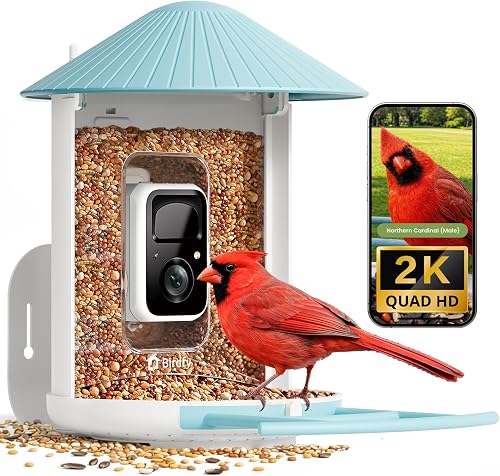 Check it
NETVUE Birdfy 2K Feeder for Beginners
Best for first-time camera birders - 7
 Check it
Kiwibit 4K 8MP Solar Bird Feeder
Best for watching on a big screen - 8
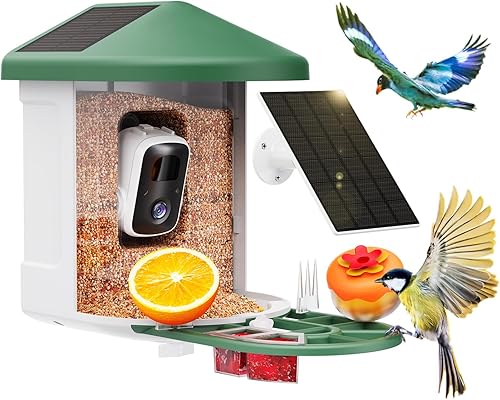 Check it
HARYMOR Solar Smart Bird Feeder
Best for big seed loads - 9
 Check it
Yinenio Smart Bird Feeder with Camera Solar
Best for color night vision
The best wireless bird feeders with cameras, ranked
The Cadrali takes the top spot for a reason: it covers the basics well without a big compromise. The rest win on specific needs, from no-subscription AI to a feeder that holds fruit and jelly.
Each card below spells out who the feeder suits, what its listed specs mean day to day and where it gives ground to the models around it.
Cadrali 3K HD Smart Bird Feeder: Best for most backyards
- 3K HD video
- AI ID for 10,000+ species
- 3W solar panel and 5000mAh battery
- IP65 waterproof and chew-proof
A 3K camera, AI species ID and solar charging in one feeder that mounts in about five minutes. The AI and cloud features need a subscription after the 30-day trial.
Pros
- Sharp 3K video
- Solar panel and 5000mAh battery
- Mounts on wall, tree or pole
Cons
- 2.4GHz Wi-Fi only
- AI ID and cloud storage need a subscription
Cadrali's feeder is the easiest recommendation for a typical backyard. The 3K camera streams live day and night, and the AI identifies more than 10,000 species and pushes an alert to your phone when a bird arrives.
The listed 1440p capture means the stream and saved clips carry real detail on feather markings.
A 3W solar panel and 5000mAh battery are meant to keep it running all year. The housing is IP65 rated and chew-proof, so rain, snow and squirrels are less of a worry.
Its 4 x 5 x 2 inch footprint is compact enough for a small yard or balcony.
Setup takes about five minutes on a wall, tree or pole, and the app walks you through pairing. Two-way audio lets you hear birdsong as you watch.
You can share live feeds with family, which makes it a strong gift for parents or kids.
The catch is the app model. AI ID and cloud storage are a 30-day trial that renews unless you cancel.
A microSD card up to 128GB gives you local storage without a plan. Against the Kiwibit, you trade lifetime AI for 3K video and a smaller, lighter body.
Kiwibit Solar Smart Bird Feeder with Camera: Best for no-subscription AI ID
- 4K video and 8MP photos
- Lifetime AI ID with no subscription
- Dual solar panels and 5200mAh battery
- 1.5L detachable seed container
Kiwibit includes lifetime AI recognition of 10,000+ species without a subscription. The dual solar panels and 5200mAh battery keep alerts and live view running.
Pros
- Lifetime AI ID included
- True 4K video and 8MP photos
- Large 1.5L seed container
Cons
- Heavier at 6.3 lb
- 2.4GHz Wi-Fi only
Kiwibit's solar feeder is the pick when you don't want to pay for AI bird ID. It includes lifetime AI recognition of 10,000+ species with one purchase, plus KeyShot galleries, visit summaries and automatic highlights.
Cloud storage runs up to 60 days for recordings of up to 3 minutes.
The camera is a true 4K unit with 8MP photos and a 132° wide view. HDR color and infrared night vision keep the picture clear after dark.
The F2.8 aperture helps in low light, so dusk visits still look good.
Power comes from dual solar panels and a 5200mAh battery. A 1.5L seed container detaches for cleaning, and optional hummingbird and squirrel-proof attachments extend what it attracts.
At 7.7 x 7.1 x 11 inches it is a sizeable feeder, so measure your mount spot first.
Up to 20 people can share live access. It's heavier than most at 6.3 lb, so plan a sturdy mount.
Against the Cadrali, it wins on resolution and AI terms but asks for a stronger mounting point.
HARYMOR by Birdnee Smart Bird Feeder: Best for feeding fruit and jelly
- 2K HD video with 120° view
- Solar roof plus adjustable external panel
- 1.5L seed container with fruit fork, jelly cup and honey jar
- Squirrel-proof mesh and app siren
A solar feeder that also holds fruit, jelly and nectar so it draws more than seed eaters. The mesh barrier and app alarm add squirrel defense.
Pros
- Fruit fork, jelly cup and honey jar included
- Two solar sources
- Squirrel-proof mesh and app siren
Cons
- AI ID needs a subscription
- 2K video, not 4K
This Birdnee feeder suits anyone who wants to draw more than seed eaters. It ships with a fruit fork, jelly cup and honey jar, so orioles and other fruit lovers have a reason to visit.
The 1.5L seed container holds a good load alongside those extras.
The 2K camera has a 120° wide angle, and the solar roof plus an adjustable external panel give it two ways to charge. The IP65 housing handles the weather.
A tilt tip in the product notes suggests angling the camera down about 15° for a clearer view of birds at the tray.
Squirrel defense is the headline: a high-density mesh barrier blocks them from the seed, and you can sound an alarm from the app when one shows up. The alarm is manual, so you tap it when you see a squirrel on the live view.
The app also sends arrival alerts and identifies birds with a subscription.
Mounting options cover a tree strap, wall bracket or a standard 1-inch pole. The base hole fits a 1-inch birdhouse pole that you supply separately.
Against the Cadrali, it gives up resolution but adds the fruit and nectar setup.
Minikey Smart Bird Feeder with Camera Outdoor: Best for long cloudy stretches
- 3K HD video with 160° lens
- Three solar panels and 5200mAh battery
- 1.25L seed capacity
- Two-way audio
Minikey says the battery can run up to 58 days on a full charge during cloudy weather. The 160° lens and two-way audio make it a strong watcher.
Pros
- Three solar panels
- Wide 160° view
- Two-way audio to hear and talk to birds
Cons
- Smaller 1.25L seed capacity
- AI ID needs a subscription
Minikey's feeder is built for yards that don't get much sun. Three solar panels (two built in, one external) and a 5200mAh battery combine to keep it running, and Minikey says it can last up to 58 days on a full charge in cloudy weather.
Treat that figure as a ceiling rather than a promise.
The 3K camera with a 160° lens takes in a wide slice of your yard, so more birds land in frame. Night vision covers after-dark visits.
A 5dB external antenna helps hold the 2.4GHz signal at the far end of a yard.
Two-way audio lets you hear birdsong and talk through the speaker, and the same speaker can be used to shoo squirrels. A 1.25L seed hopper and a funnel roof keep food dry.
The stated range of -10℃ to 45℃ covers most climates.
It's smaller on seed than the top picks, so expect more refills if you host a crowd. The included mini hummingbird feeder adds nectar to the mix.
Against the Cadrali, the extra solar panel is the draw, but the hopper is smaller and the AI still needs a subscription.
Bird Buddy Pro Solar Smart Bird Feeder: Best for the polished app
- 2K video and 5MP HDR photos
- AI species and bird-level ID
- Solar roof included
- Mounts by hanger or pole
Bird Buddy's app identifies species and individual birds and sends alerts when one lands. The 2K HDR camera and 5MP photos look bright and sharp.
Pros
- AI ID for species and individual birds
- HDR sensor for color and contrast
- Solar roof included
Cons
- Smallest seed capacity here at 0.9L
- Premium AI features need a subscription
Bird Buddy's Pro model is the pick for app polish. Its 2K camera uses a larger sensor with HDR, so colors and contrast look vivid in 5MP photos and 2K video.
The app identifies species and even individual birds, and sends alerts when one lands.
A solar roof keeps the rechargeable battery topped up. You can hang it from a branch with the included hanger or mount it on a pole you supply.
The kit also includes a seed scoop, a USB-C cable and a universal mount with screws.
The seed capacity is the smallest in this group at 0.9L. That means more frequent refills, though it also keeps seed fresher.
Its 6.89 x 6.3 x 9 inch footprint suits a small garden or balcony, though Cadrali lists smaller dimensions.
AI ID and advanced features run through a subscription. Core features like live streaming, species ID and sharing are free.
The app can invite up to 10 people to your feeder. Against the Kiwibit, you pay for a subscription but get the most polished app and bird-level ID.
NETVUE Birdfy 2K Feeder for Beginners: Best for first-time camera birders
- 2K video with 155° view
- AI ID for about 11,000 species
- 5200mAh battery, 3 to 6 months per charge
- 5GB free cloud storage
Birdfy's classic feeder records short clips when birds arrive and stores them free for 30 days. Core features are free, with AI ID as the paid extra.
Pros
- Free recording, alerts and 5GB cloud storage
- 155° wide view
- Long battery life between charges
Cons
- Battery only, no solar panel
- AI ID needs a subscription
Birdfy's first-generation feeder is a solid first camera feeder for a beginner. It auto-records a short clip when a bird arrives and sends a notification, and the core features stay free: live view, alerts, 30-day video history and 5GB cloud storage.
You can adjust the camera's detection sensitivity to suit your yard.
The 2K camera has a 155° wide view, and the app's AI recognizes about 11,000 species, though AI ID needs a subscription. The 5200mAh battery runs 3 to 6 months per charge.
It also works with Alexa and offers a free 24/7 Bird Expert chat in the app.
The trade-off is power. There's no solar panel in the box, so you'll charge by USB-C.
In return you get a simpler feeder and a low-maintenance routine. Against the solar picks, it asks more of you in exchange for the most generous free tier.
It holds up to 50 oz (3.1 pounds) of seed and mounts on a pole, wall or tree with the tools included. Sharing is free for 20 or more people.
Kiwibit 4K 8MP Solar Bird Feeder: Best for watching on a big screen
- 4K HDR live streaming and 8MP photos
- External adjustable solar panel and 5200mAh battery
- 132° wide-angle view
- Shares live view with 3 people
A 4K stream and 8MP photos suit watching on a TV or tablet. The adjustable solar panel can be placed away from the feeder for more direct sun.
Pros
- 4K HDR live view and 8MP photos
- External solar panel can be repositioned
- 1.5L seed container
Cons
- AI ID only as a 30-day trial
- 2.4GHz Wi-Fi only
Kiwibit's second entry here focuses on the viewing experience. Its 4K HDR live stream and 8MP photos are the sharpest on the list, which matters if you watch on a TV or large tablet.
The 132° wide view keeps the frame broad enough for several birds at once.
The external solar panel is adjustable and can be placed away from the feeder to catch more sun. A 5200mAh battery handles cloudy stretches, and the feeder is rated to work from -4°F to 122°F.
USB-C charging covers long grey spells.
Live viewing is free without a subscription, and you can share it with up to 3 people at once. Recorded moments can be shared with up to 20 users.
AI species ID runs as a 30-day trial.
The 1.5L seed container is easy to refill, and a microSD card up to 512GB gives you room for 4K clips. Against the Kiwibit with lifetime AI, the picture is the same but the AI terms are weaker, which is why it ranks lower.
HARYMOR Solar Smart Bird Feeder: Best for big seed loads
- 2K video with 120° view
- 2L seed container
- Two 3W solar panels
- 3X magnification close-ups
The 2L seed container cuts how often you refill. Built-in and external solar panels keep the 2K camera running without frequent charging.
Pros
- Largest seed capacity here at 2L
- Two solar panels
- 3X zoom for close-ups
Cons
- 2K video only
- AI ID needs a subscription
HARYMOR's solar feeder is the one to pick when you don't want to refill often. Its 2L seed container is the largest here, and the funnel roof keeps food dry.
The IP65 housing shrugs off rain and snow.
Built-in and external 3W solar panels keep the 2K camera charged, and a 5dBi external antenna helps hold a 2.4GHz connection. A 120° lens covers the feeder area, and 3X magnification brings feather detail closer.
Night vision means you can check evening visits too.
AI species ID covers 10,000+ birds with a subscription. Video saves to a memory card up to 128GB or to cloud storage, and a 3-day loop cloud trial is included.
The app supports multiple users for sharing clips.
It's 2K rather than 3K or 4K, so the picture is good but not the sharpest. For a busy feeder that empties fast, the bigger hopper saves trips outside.
It mounts on a tree or wall only, so a pole setup needs a different pick.
Yinenio Smart Bird Feeder with Camera Solar: Best for color night vision
- 5MP video and 2880x1616 resolution
- Full-color night vision up to 20 ft
- Built-in solar panel and battery
- IP66 waterproof
Yinenio's 5MP camera and four infrared LEDs give full-color night video up to 20 ft. A built-in solar panel keeps it running in decent sunlight.
Pros
- Full-color night vision up to 20 ft
- 5MP detail above 1080p
- IP66 weatherproof rating
Cons
- Built-in solar panel only
- AI ID needs a subscription after the free month
Yinenio's feeder stands out for after-dark watching. Four infrared LEDs give full-color night vision up to 20 ft, and the 5MP camera captures at 2880x1616, which is sharper than 1080p.
The 130° wide lens keeps a broad view of the tray.
A built-in solar panel and battery keep it running in decent sunlight. It's IP66 rated and comes with a chew-proof cable to keep squirrels off the seed.
A 1-month free cloud trial is included that does not use your phone's memory.
AI ID covers 15,000+ species, and after the trial AI recognition and cloud features need a subscription. Local recording to a microSD card up to 128GB works without one.
The app also offers 24/7 technical support.
The solar panel is built in rather than adjustable, so placement matters more in shade. Against the Cadrali, the night vision is better but the power setup is less flexible.
It's a good fit for a yard where evening visits are the highlight.
How these wireless feeder cameras compare
The table lines up the specs that change the buying decision most: video quality, how each one charges and what the app asks you to pay for. Scan it for the features you care about, then read the write-up for that model.
| Product | Best for | Video | Power | Wi-Fi | Our score |
|---|---|---|---|---|---|
| Cadrali 3K HD Smart Bird Feeder | most backyards | 3K HD, 1440p capture | 3W solar panel, 5000mAh battery | 2.4GHz only | 9.7 |
| Kiwibit Solar Smart Bird Feeder with Camera | no-subscription AI ID | 4K, 8MP photos | Dual solar panels, 5200mAh battery | 9.5 | |
| HARYMOR by Birdnee Smart Bird Feeder | feeding fruit and jelly | 2K HD | Solar roof plus external panel | 9.2 | |
| Minikey Smart Bird Feeder with Camera Outdoor | long cloudy stretches | 3K HD | 3 solar panels, 5200mAh battery | 8.8 | |
| Bird Buddy Pro Solar Smart Bird Feeder | the polished app | 2K, 5MP photos | Rechargeable battery, solar roof | 8.6 | |
| NETVUE Birdfy 2K Feeder for Beginners | first-time camera birders | 2K | 5200mAh battery | 8.3 | |
| Kiwibit 4K 8MP Solar Bird Feeder | watching on a big screen | 4K HDR, 8MP photos | 3W solar panel, 5200mAh battery | 7.6 | |
| HARYMOR Solar Smart Bird Feeder | big seed loads | 2K | Built-in and external solar panels | 7.2 | |
| Yinenio Smart Bird Feeder with Camera Solar | color night vision | 5MP, 2880x1616 | Built-in solar panel | 2.4GHz only | 7.1 |
How we compared these wireless bird feeders
We ranked these by checking the specs each feeder lists and matching them to what a wireless camera feeder buyer needs. Video resolution, power source, seed capacity, mounting options and app costs carried the most weight.
A 3K or 4K camera scores higher than a 2K one, because more detail means better bird ID and more satisfying clips. Solar charging with a large battery beats battery-only.
Two solar panels or an adjustable external panel earn extra credit for yards in partial shade.
Subscription terms mattered too. A feeder that includes AI ID or keeps core features free ranks above one that charges for basic identification.
That's why the Kiwibit with lifetime AI sits high and why Birdfy's free tier lifts a battery-only model into the top half.
Seed capacity and mounting flexibility shaped the rest of the order. A 2L hopper lasts longer between refills, and a feeder that covers tree, wall and pole mounts fits more yards.
Small details counted as well, like two-way audio, night vision and how many people can share the feed.
What should you check before buying a wireless feeder camera?
Start with your Wi-Fi. Every feeder here needs a 2.4GHz network, and none work on 5GHz alone.
If your router runs both bands under one name, you may need to split them during setup. A 5dBi or 5dB external antenna, like the ones on the HARYMOR and Minikey models, helps hold the signal at the far edge of the yard.
Think about where the feeder will hang. A tree, wall or pole changes how much sun reaches the solar panel.
In shade, an external or adjustable panel helps more than a built-in one. The Birdfy model has no panel at all, so its 5200mAh battery has to carry the load.
Decide how you feel about subscriptions. Some feeders keep alerts and recording free and charge only for AI ID.
Others include AI ID for life. The difference matters over a couple of years.
Check whether cloud storage comes with the trial or costs extra once it ends.
Check seed capacity against how often you want to refill. A 2L hopper lasts longer than a 0.9L one, which helps in winter or when you travel.
For more detail on matching features to your yard, our camera bird feeder buying guide walks through each spec.
Is 2.4GHz Wi-Fi really required?
Yes. The cameras here connect over 2.4GHz only, because that band reaches farther outdoors than 5GHz.
Place the feeder within range of your router or a mesh node. If your network only broadcasts 5GHz, the camera won't pair at all.
How much do subscriptions cost?
We don't list prices, but expect an optional plan for AI ID and extra cloud storage on most models. Kiwibit includes lifetime AI ID, and Birdfy keeps core features free.
Check each app's terms before you buy. The free trials here run from 30 days to a month, so note the renewal date.
Which mounting setup suits your yard?
Pick your mount by where you get the best view and sun. A tree strap is the simplest for most yards.
A wall bracket works for a fence or shed, and a pole mount lifts the feeder clear of cats and squirrels.
Most picks here include two or three mount types. Cadrali covers wall, tree and pole in five minutes.
HARYMOR by Birdnee includes a strap, wall bracket and a base hole for a 1-inch pole you supply. Bird Buddy includes a hanger and a universal pole mount but leaves the wall bracket as an extra.
Tree or pole?
A tree mount blends into the yard and gives birds a natural perch nearby. A pole mount, like the one Kiwibit supports, moves the feeder where the light and view are best.
A pole also makes it harder for squirrels to climb to the feeder.
Wall or window?
A wall mount saves space and suits a fence or shed. For glass, a window feeder puts the action inches away.
Our window bird feeder with camera picks cover those mounts. HARYMOR's solar feeder is tree or wall only, so skip it if you want a pole.
Solar, battery or both?
Solar is the better default for a wireless feeder, because it cuts the charging routine. A panel plus a large battery keeps alerts and live view going through most weather.
The Kiwibit models use solar panels and a 5200mAh battery. The Minikey adds three panels for cloudy stretches.
The Cadrali pairs a 3W panel with a 5000mAh battery. Yinenio's panel is built in, so the angle it lands at is fixed.
When battery-only makes sense
A battery-only feeder suits a shaded yard or a spot where a panel won't get sun. Birdfy's 5200mAh battery runs 3 to 6 months per charge.
If you don't mind charging a few times a year, it's a simpler setup. For more solar picks, see the bird feeder with camera and solar roundup.
Can you add a panel later?
Sometimes. Kiwibit and Minikey sell solar panels and accessories separately.
Birdfy's box has no panel, so confirm one is available for your model before you rely on solar. The Minikey external panel and Kiwibit's adjustable panel both plug into their own feeders.
How much resolution do you need?
2K is enough for most people, since it identifies birds clearly on a phone. Go to 3K or 4K if you watch on a larger screen or save clips to revisit.
Resolution also affects how much detail the AI has to work with.
The Kiwibit 4K models top the resolution list with 8MP photos. Cadrali and Minikey offer 3K.
The rest sit at 2K or 5MP. Yinenio's 2880x1616 sits between 1080p and 4K, which is a fair middle ground.
Higher resolution also means bigger files. A 128GB card fills faster with 4K video, so plan storage.
The Kiwibit 4K 8MP model supports cards up to 512GB for that reason.
Is 2K good enough for bird ID?
Yes. Bird ID depends more on AI training and a clear, close view than raw resolution.
A 2K camera with a wide lens catches enough detail. A 4K camera helps when the bird is small in the frame.
A tilt adjustment, like the one Birdnee suggests, can matter more than extra pixels.
Do these feeders record at night?
Most do. Cadrali, Kiwibit, Minikey, HARYMOR and Yinenio all offer night vision.
Yinenio's full-color night vision up to 20 ft is the most detailed here. Infrared gives clear black-and-white video on the others.
Check whether night vision works on battery alone or needs the solar panel topped up.
What does the app include without a subscription?
Core features like live view, motion alerts and local recording usually stay free. The paid part is typically AI species ID and larger cloud storage.
Birdfy is the most generous on free features, with alerts, 30-day history and 5GB cloud storage at no cost. Kiwibit includes lifetime AI ID.
Cadrali, Minikey, HARYMOR and Yinenio include a trial before a subscription is needed. Bird Buddy keeps live streaming and species ID free and charges for the deeper features.
Can you watch without Wi-Fi?
No. These are wireless in the sense that they run on Wi-Fi and solar or battery power, not cellular.
Without a 2.4GHz connection, the camera can't stream to your phone. Local recording on a memory card still works, but you need the app to review clips.
How many people can share the feed?
It varies. Minikey supports 30 or more users, Kiwibit allows up to 20, and Birdfy shares with 20 or more.
Cadrali, HARYMOR and Bird Buddy let a smaller group watch. Sharing works through the app, so each person needs an account.
Bird Buddy's free tier includes sharing with up to 10 people.
Verdict: which wireless bird feeder camera should you buy?
For most yards, buy the Cadrali 3K HD Smart Bird Feeder. It gives you a sharp 3K view, solar charging with a 5000mAh battery and a five-minute mount, all in one feeder.
Choose the Kiwibit 4K model if you want the best picture and lifetime AI ID without a subscription. Pick the HARYMOR by Birdnee feeder to attract fruit and jelly eaters, or the Minikey for a shaded yard where three solar panels help.
If you're just starting out, the Birdfy 1 Series keeps the core features free and simple (AI ID costs extra). For the sharpest big-screen viewing, the Kiwibit 4K 8MP is the one to get.
Whichever you choose, confirm your Wi-Fi is 2.4GHz and your mount spot gets some sun. That's the difference between a feeder you watch daily and one that sits idle.
Our top 3 picks at a glance
-
1
-
2
Best for no-subscription AI ID
Kiwibit Solar Smart Bird Feeder with Camera
9.5/10 our score
See it on Amazon -
3
Best for feeding fruit and jelly
HARYMOR by Birdnee Smart Bird Feeder
9.2/10 our score
See it on Amazon
Frequently asked questions
Do wireless bird feeders with cameras need Wi-Fi?
Yes. Every feeder here connects over 2.4GHz Wi-Fi, so place it within reach of your router or a mesh node.
A 5GHz-only network won't work, so check which band your router broadcasts before you buy.
Do I need a subscription to use a camera bird feeder?
Not for the basics. Live view, motion alerts and local recording on a memory card work without one on most models.
AI species ID and larger cloud storage are the usual paid extras, though Kiwibit includes lifetime AI ID.
Will squirrels and rain damage a wireless feeder camera?
Most picks here carry an IP65 or IP66 rating, so rain and snow are handled. Several add chew-proof cabling or a mesh barrier, and the HARYMOR by Birdnee feeder includes an app alarm to scare squirrels off.
Can more than one person watch the feeder?
Yes. Shared access varies by model: Kiwibit allows up to 20 people, Minikey supports 30 or more, and Cadrali and HARYMOR let a few family members watch.
Everyone needs the app and an account.
How much sun does a solar bird feeder camera need?
Plan on several hours of direct sun a day to keep the battery topped up. In shade or long cloudy spells, most models let you pull the battery and charge it over USB-C.
An external solar panel helps in partial shade.
What video quality should I expect from these feeders?
Models here range from 2K to 4K, and the number matters for how much feather detail you can see. 2K is fine for identifying birds on a phone.
4K is worth it if you watch on a larger screen or like to save clips.


